
Budgeting app onboarding: first 10 screens scored
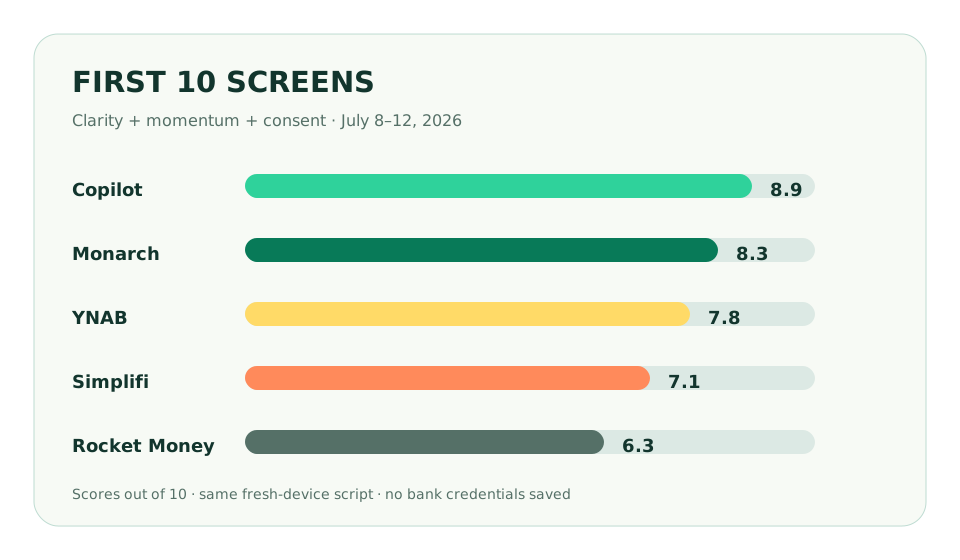
Copilot Money has the best first-run experience of the five budgeting apps we audited, scoring 8.9/10. Monarch follows at 8.3. Both explain why a step matters before asking for financial access. Rocket Money finishes last at 6.3 because promotional choices interrupt the core setup more often than they help it.
This is an onboarding teardown, not a full product ranking. From July 8 through July 12, 2026, three PurseMint editors installed Copilot Money, Monarch Money, YNAB, Quicken Simplifi, and Rocket Money on clean devices. We stopped after the tenth meaningful screen, excluding operating-system permission sheets but counting every product decision. Each editor narrated what they expected the next tap to do before taking it.
We awarded 2.5 points each for clarity, momentum, consent, and recovery. Clarity asks whether the screen says what is happening. Momentum measures whether each request earns its place. Consent covers data access, trials, and notifications. Recovery asks whether skip, back, and correction routes are visible. The result is deliberately narrower than the six-category method behind our 2026 budgeting-app ranking.
| App | Clarity | Momentum | Consent | Recovery | Total |
|---|---|---|---|---|---|
| Copilot Money | 2.4 | 2.3 | 2.1 | 2.1 | 8.9 |
| Monarch Money | 2.2 | 2.0 | 2.1 | 2.0 | 8.3 |
| YNAB | 2.1 | 2.2 | 1.8 | 1.7 | 7.8 |
| Quicken Simplifi | 1.9 | 1.7 | 1.8 | 1.7 | 7.1 |
| Rocket Money | 1.8 | 1.5 | 1.4 | 1.6 | 6.3 |
Copilot: a clear promise before the permission
Copilot’s first screen names a concrete outcome: see spending in one place. The next screens establish categories and recurring transactions before asking for a bank connection. That sequence makes access feel like a tool, not a tollbooth. Screen six offered a legible explanation of connection security; screen eight previewed the review loop that users would perform after import.
The flow was not perfect. The trial explanation arrived later than we wanted, and the value of notification permission was too general. Still, optional choices looked optional. Back navigation preserved earlier answers in all three runs. We reached a useful demo state in 2 minutes 46 seconds, the fastest complete orientation in the set. Our six-week Copilot review shows whether that early calm survives daily use.
Monarch: candid, capable, slightly crowded
Monarch scored highest for consent at 2.1, tied with Copilot. It explained household access without implying that a second person was required, and it separated institution connection from marketing communication. The flow also acknowledged that accounts may need troubleshooting. That small dose of realism builds more trust than a frictionless-animation fantasy.
Its 8.3 score reflects density. By screen ten, testers had encountered household setup, goals, connection, planning style, and personalization. Every concept was defensible, but the sequence asked new users to form a mental model before seeing enough real data. Median time was 4 minutes 18 seconds. Monarch’s strength is breadth; onboarding cannot completely hide the cost of that breadth.
YNAB: teaching is the product
YNAB used its ten screens to introduce the idea of assigning money, not merely to configure software. That earned 2.2 for momentum: most screens advanced a coherent lesson. The tradeoff appeared in recovery. Skipping the instructional route made later labels harder to interpret, and two testers were unsure whether a target could be revised safely after setup.
The flow works best when a user has already chosen zero-based budgeting. Someone still comparing methods may experience the lesson as commitment before evidence. We reached the first usable plan in 5 minutes 11 seconds, but that number understates the thinking required. A longer flow is not automatically worse; an unexplained commitment is.
Simplifi and Rocket Money lose the thread
Simplifi’s individual screens were readable, yet the flow moved among income, bills, watchlists, and its Spending Plan without a stable explanation of how those objects fit together. Three labels sounded equally central. We backed up twice to check whether a skipped watchlist would weaken the plan. Nothing broke, but the uncertainty reduced both momentum and recovery scores.
Rocket Money made the clearest early case for subscription detection, then diluted it with premium positioning and notification prompts. Of its first ten screens, three asked for a choice connected to conversion or continued attention rather than establishing the budget. The language was polished; the sequencing was not neutral. A user can still complete setup, but the product asks for trust faster than it explains consequences.
What the ten-screen limit revealed
Screen count was a useful constraint because every team gets the same attention budget. The winner did not cram more into ten screens. Copilot made the current job obvious, Monarch exposed complexity honestly, and YNAB taught one model. The lower scorers changed subjects. Across 50 screens, testers correctly predicted the next result 43 times for Copilot, 40 for Monarch, 38 for YNAB, 34 for Simplifi, and 30 for Rocket Money.
The practical test during any trial is to pause before bank connection. Can you state what data will arrive, what the app will do with it, and how to undo a mistake? If not, skip the connection or leave. Our budgeting-app selection guide turns that pause into a two-week trial script.
Onboarding audit FAQ
Which budgeting app has the best onboarding in 2026?
Copilot Money led our July 2026 audit with 8.9 out of 10, followed by Monarch Money at 8.3. Copilot stated the job of each step clearly and postponed optional setup without making the experience feel incomplete.
Do users need to connect a bank during onboarding?
No. A trustworthy onboarding flow should explain what bank connection enables and offer a safe preview or manual path. We deducted points when an app made connection feel mandatory before explaining data access and recovery.
How did PurseMint score the first ten screens?
We gave each screen up to 2.5 points for clarity, momentum, consent, and recovery. Three editors repeated the same fresh-device script from July 8 through July 12, 2026, then reconciled scoring differences.