LOBy Lena Ortiz, research editor · Published and checked August 5, 2026 · 12 min read
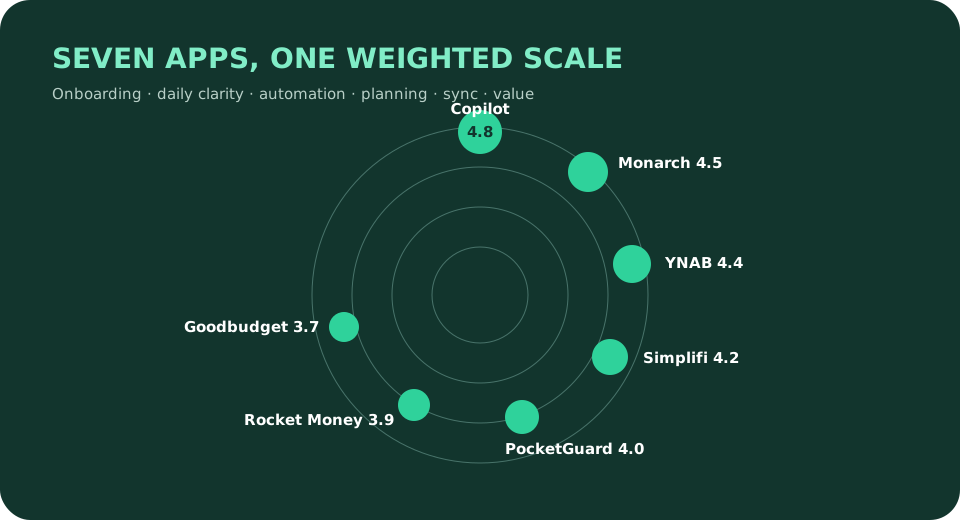
Copilot Money is the best budgeting app for most people in 2026, with a 4.8/5 PurseMint score. Monarch Money ranks second and is better for couples; YNAB ranks third and remains best for strict zero-based budgeting. We tested every pick daily for at least four weeks and paid for our own access.
This ranking favors the part of budgeting that repeats: importing, understanding, correcting, and acting on transactions. Every app faced the same core tasks and six weighted categories. Scores are not app-store averages. They are our editorial measurements, rounded to one decimal. Prices below are standard US prices checked August 5, 2026; promotions, taxes, and regional billing can differ.
All seven scores use the same six weighted categories. Distance around the orbit shows rank, not market share.
Best budgeting apps: scores, prices, and ideal users
Rank
App
Score
Standard price
Best for
1
Copilot Money
4.8
$13/mo or $95/yr
Daily review
2
Monarch Money
4.5
$14.99/mo or $99.99/yr
Couples
3
YNAB
4.4
$14.99/mo or $109/yr
Zero-based budgeting
4
Quicken Simplifi
4.2
$5.99/mo, billed annually
Cash-flow forecasting
5
PocketGuard
4.0
Free trial; $12.99/mo or $74.99/yr
Spendable number
6
Rocket Money
3.9
Free; Premium price varies
Subscription cleanup
7
Goodbudget
3.7
Free; $10/mo or $80/yr
Manual envelopes
01
Best overall
Copilot Money
Copilot makes the recurring job of transaction review faster than any competitor we tested. Its queue, category rules, recurring-payment timeline, and visual hierarchy work as one coherent system. After the first week, 94% of our incoming transactions were categorized correctly on the first pass.
The catch: there is no native Android app as of our August check, household collaboration is limited, and the $95 annual fee is excessive for someone who only checks monthly totals. Read our complete Copilot Money review or visit the official Copilot site.
4.8 /5
02
Best for couples
Monarch Money
Monarch gives partners separate logins to one household view, with flexible plans, rollovers, tags, notes, goals, and broad account coverage. Its iOS, Android, and web support makes it the practical cross-platform choice. Planning tools scored 4.8/5, the highest planning result in this group.
The catch: information-dense screens take longer to learn, and reviewing 20 matched transactions took 53 seconds longer than in Copilot. The $99.99 annual renewal is worthwhile only if the household uses the breadth. See our Monarch Money review and direct comparison.
4.5 /5
03
Best method
YNAB
YNAB is the strongest choice for people who want every available dollar assigned to a category before it is spent. Its method, educational material, target system, and loan planner encourage forward decisions instead of passive reporting. Shared access and broad platform support are mature.
The catch: the method has a real learning curve, the first plan takes work, and $14.99 monthly or $109 annually is the highest annual standard price in our ranking. Users who want automatic observation more than deliberate allocation may churn. Confirm current terms on the official YNAB site.
4.4 /5
04
Best forecast
Quicken Simplifi
Simplifi’s Spending Plan is an effective middle ground: projected income and bills establish what remains for planned and unplanned spending. Watchlists make a specific merchant or category easy to monitor. At the standard $5.99 monthly price billed annually, it undercuts our top three.
The catch: the relationship among the Spending Plan, watchlists, bills, and reports is not instantly obvious. We needed more orientation than the marketing suggests, and some connection troubleshooting echoed Quicken’s desktop-era complexity. It scored well, but daily interaction lacks Copilot’s calm.
4.2 /5
05
Best quick limit
PocketGuard
PocketGuard centers an “In My Pocket” amount: money left after income, bills, goals, and planned spending. That single number can help people who do not want to inspect a full category plan. Debt payoff and bill tools add useful structure. Standard Plus pricing was $12.99 monthly or $74.99 annually.
The catch: a single spendable number can hide the assumptions underneath it. New users must verify bill detection, income timing, and category rules before trusting the result. The interface also promotes several capabilities around the core number, making setup feel busier than the product’s simple promise.
4.0 /5
06
Best subscriptions
Rocket Money
Rocket Money is most useful as a subscription-finding and bill-awareness tool. It surfaces repeating charges quickly, combines credit and spending context, and offers a free starting experience. Premium pricing varies by selected plan and billing option rather than presenting one simple universal rate.
The catch: cancellation and bill-negotiation features can distract from building a durable monthly plan. Premium choice adds checkout ambiguity, and users should read any fee terms before requesting bill negotiation. We would choose it to clean recurring expenses, not as the strongest all-purpose budget system.
3.9 /5
07
Best manual envelopes
Goodbudget
Goodbudget translates the envelope method into a simple digital ledger. Manual entry keeps users aware of each purchase, and household syncing supports a shared envelope plan. The free tier is useful for testing; Premium was $10 monthly or $80 annually when checked.
The catch: manual upkeep is the feature and the liability. People expecting broad automatic bank synchronization or rich investment tracking will find it limited. The interface is functional rather than refined, and Premium costs close to more automated competitors. Choose it only when conscious manual entry supports your habit.
3.7 /5
How we tested and chose
Each app stayed active for at least 28 days and one pay cycle. We connected real accounts when supported, imported or entered the same edge cases, and scored onboarding 15%, daily clarity 25%, automation 15%, planning 20%, connection reliability 15%, and value 10%. A failed connection was retested before it affected a score. Our complete editorial methodology explains the log and conflict-review process.
The best app is not automatically the one with the most features. Start with the behavior you will repeat and the people who need access. Our eight-question choosing guide turns that principle into a short trial plan. Exportability, institution compatibility, and a comprehensible month-end review should matter more than a launch-week discount.
Editorial integrity: PurseMint accepts no sponsored placements or affiliate commissions. Scores reflect standard pricing and our observed test accounts as of August 5, 2026.